
Million-dollar RFPs: what enterprise merch programs actually ask for
After five years of answering branded merch RFPs from $500K to multi-million-dollar annual budgets, the pattern is clear: competitive pricing and on-time delivery are table stakes. What enterprises really want is a partner who runs the whole program — storefront, inventory, print-on-demand, rebates, and a dedicated team.
· Spencer MacKay · 7 min read
Key takeaways
- Every large branded merch RFP treats competitive pricing, good products, and on-time delivery as the baseline. The deciding factor is whether the vendor can manage the logistics of a program spanning hundreds or thousands of employees across many locations.
- Nearly every enterprise RFP requires the vendor to build and manage a company storefront where employees redeem gifts, spend credits, or buy merch — and a platform behind it to track budgets, department spending, users, and orders.
- General e-commerce platforms like Shopify are built for retail, not branded merch: issuing gift cards and employee credits and tracking redemptions against a corporate budget is where they break down.
- A hard RFP requirement is one checkout that mixes inventoried items (already paid for by the client) with print-on-demand items (paid at checkout). Swelo storefronts split that payment automatically.
- Enterprise programs expect a volume incentive: Swelo Rewards returns 5% on bulk orders, and net terms are negotiable — net 30 standard, net 45 and net 60 available.
- 'Logistics' in an RFP means two things: a dedicated account team with promo-industry experience, and a warehouse that picks, kits, and ships within 24–48 hours of an order.
A branded merch RFP (request for proposal) is how a large company chooses the vendor that will run its swag program — usually for a year or more, and usually for six or seven figures of annual spend. Over the last four and a half, almost five years in the branded merch industry, I've had the opportunity to participate in a handful of these, ranging from $500,000 in annual spend to multi-million-dollar annual budgets.
Across all of them I've seen one common theme: the company needs far more than somebody who can source branded merch. Obviously the partner they're looking for needs competitive pricing, great products, and on-time delivery. All of that is simply expected. What they really want is a partner who can manage every piece of logistics that goes into an enterprise-level program — hundreds or thousands of employees, with locations across the country or the world.
That's the reason I built Swelo: to help enterprise customers — and non-enterprise customers too — manage their merch programs end to end. A good branded merch partner is more than a company that sources quality products and delivers on time. They're a partner who helps from the beginning to the end and makes your life easier. Here's what I've seen these RFPs require, section by section, and how the Swelo Hub answers each one.
What does an enterprise branded merch RFP require?
The requirements vary in wording, but the same five show up in almost every large RFP I've answered:
- A company storefront — a custom online store, built and managed by the vendor, where employees redeem gifts, spend credits, and browse every swag item.
- A management platform — one place to see the budget, automate gifting, track spending by department, and manage everyone with an account on the store.
- Inventory and print-on-demand together — pre-purchased stock and on-demand items sold side by side, in one checkout.
- A rebate and payment terms — a bulk-order discount or rebate tied to volume, plus net terms rather than card-on-file.
- Logistics — a dedicated account team and a 3PL warehouse that stores, kits, and ships the program's inventory.
Storefronts: the requirement in almost every RFP
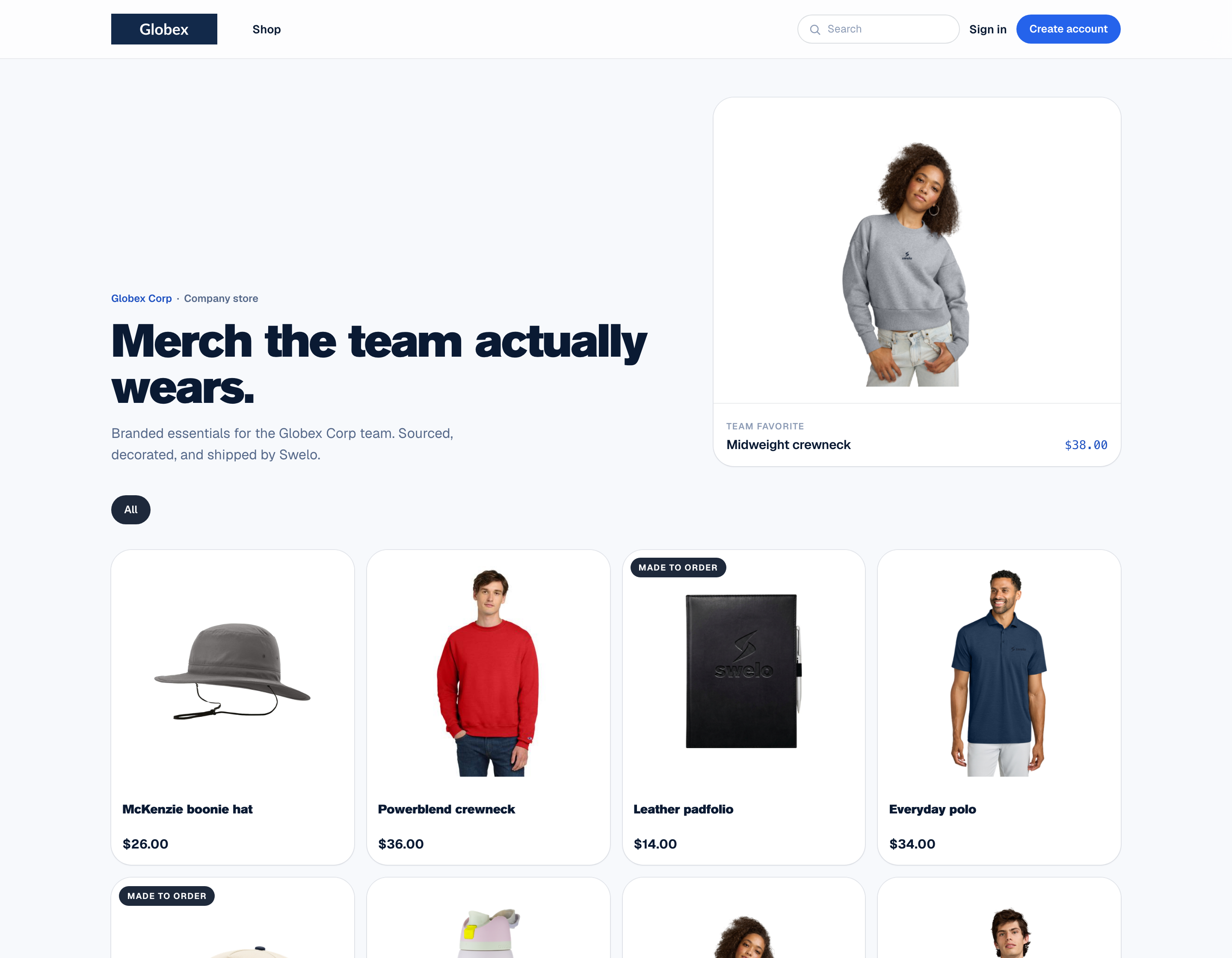
Almost every single RFP I've participated in has required us, as the vendor, to create and manage a storefront. These storefronts do a variety of things, but the most important job is the same: a place where employees go to redeem branded merch gifts or purchase them, and a place that showcases every swag item the company offers.
The difficult part is the gifting side. Typical e-commerce platforms like Shopify or WooCommerce do a great job building a retail store, but they struggle with the back-end logistics of sending gift cards or issuing credits to employees so those employees can redeem branded merch. Shopify is made for e-commerce. It is not made for the branded merch industry.
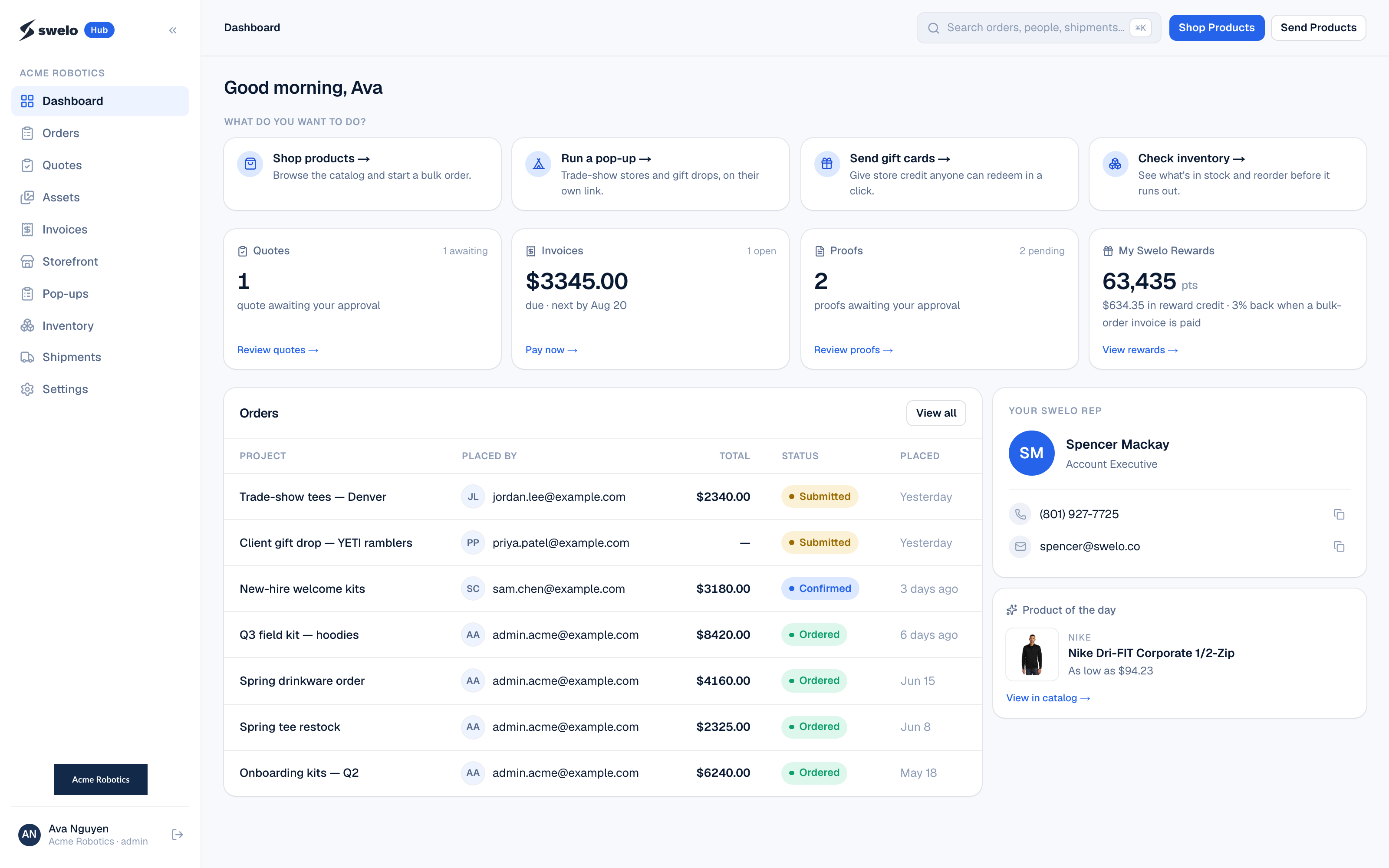
This is exactly why the Swelo Hub exists. You can fully build and customize a branded storefront to your exact needs and brand guidelines. From the Hub dashboard you track and manage every user and employee with an account on the storefront, issue gift cards, send credits, and follow every order — whether it's fulfilled from your inventory or from print-on-demand items, which brings us to the next requirement.
Inventory and print-on-demand in one checkout
One of the harder asks in these RFPs is a storefront that carries both inventoried items and print-on-demand (POD) items. Picture an employee checking out with an inventoried hat and a print-on-demand t-shirt. The client has already paid for the hat — it's sitting in the warehouse — but nobody has paid for the t-shirt yet, because it doesn't exist until it's ordered.
Because the Swelo Hub and our storefronts were built for this industry, that problem is eliminated: the checkout handles the split automatically, so a single store can carry pre-purchased inventory and on-demand items side by side.
On top of that, Swelo has access to 50,000 square feet of warehouse space where we hold, manage, and track your inventory. From your Hub account you have live eyes on every inventory level and can easily re-order items that are running low. I covered how the store, the inventory, and the warehouse fit together in Company storefronts, explained.
Rebates and net terms
Some of the RFPs I've worked on have asked for a bulk discount or rebate. Swelo answers that with Swelo Rewards: enterprise programs earn 5% back on all bulk orders. At enterprise volume that's thousands — sometimes tens of thousands — of dollars a year returned to the program.
Payment terms are the other half of this section in most RFPs. We're willing to negotiate net terms: net 30 is our standard, and we have worked with net 45 and even net 60.
Logistics: a dedicated team and a 24–48 hour warehouse
When an RFP says logistics, it isn't only talking about shipping and fulfillment. It's also talking about the team dedicated to the account. Every RFP I've worked on has required the vendor to assign a team, and Swelo is no different: we assign a dedicated team with experience across the promotional products industry — product sourcing, decoration, and IT. That team is responsive, quick to fix issues, and willing to do whatever it takes to get the job done.
Then there's the actual 3PL side, which ties back to inventory. Our warehouse team picks, pulls, kits, and ships items within 24 to 48 hours of any order being placed — the same fulfillment that serves the storefront, pop-up stores, and bulk shipments.
Running an RFP this year? Include Swelo
We would love the opportunity to participate in your upcoming RFP. We're confident the Swelo Hub — storefront, inventory management, print-on-demand, and product sourcing in one platform — will benefit your entire brand. RFPs are hard to create, issue, and score, and if you're comparing vendors, our SwagUp alternatives breakdown covers how the major platforms stack up on these same requirements.
Have questions before you send it out? Book a call or email me directly at spencer@swelo.co. We're here to help.
Frequently asked questions
- What do enterprise companies require in a branded merch RFP?
- Beyond competitive pricing, quality products, and on-time delivery, large branded merch RFPs typically require five things: a custom company storefront built and managed by the vendor, a platform to manage budgets, gifting, and department spending, inventoried and print-on-demand products in the same store, a volume rebate with net payment terms, and a dedicated account team backed by 3PL warehouse fulfillment.
- Does a branded merch vendor need to provide a company store?
- In almost every enterprise RFP, yes. The storefront is where employees redeem gifts, spend credits, or buy merch, and where the company showcases its full swag catalog. RFPs ask the vendor to build and manage it because the store has to connect to the vendor's inventory and fulfillment.
- Why not run a company swag store on Shopify?
- Shopify and WooCommerce are built for retail e-commerce. A company store has to issue gift cards and per-employee credits, track redemptions against a corporate budget, and fulfill from inventory the company already owns. Those back-end gifting and budget mechanics are where general e-commerce platforms break down, which is why purpose-built platforms like the Swelo Hub exist.
- Can a company store sell inventoried and print-on-demand items together?
- On Swelo, yes. The challenge is payment: the client has already paid for inventoried items, while print-on-demand items must be paid at checkout. Swelo storefronts split that payment automatically in a single transaction, so one store can carry pre-purchased stock and on-demand items side by side.
- Do branded merch vendors offer rebates on bulk orders?
- Many enterprise RFPs ask for one. Swelo offers 5% back on bulk orders through Swelo Rewards for enterprise programs, which at enterprise volume returns thousands to tens of thousands of dollars a year to the program.
- What payment terms do promotional product vendors offer on large programs?
- Net 30 is the standard at Swelo. Net 45 and net 60 are negotiable for enterprise programs, and both have been used on past RFP-awarded accounts.
- What does 'logistics' mean in a merch RFP?
- Two things. First, a dedicated account team with promotional-products experience across sourcing, decoration, and IT. Second, the physical 3PL operation: a warehouse that stores the program's inventory and picks, kits, and ships orders. Swelo's warehouse ships within 24–48 hours of an order.
- How much warehouse space does Swelo have for program inventory?
- Swelo has access to 50,000 square feet of warehouse space where client inventory is stored, tracked, and fulfilled. Live inventory levels and re-ordering are visible from the Swelo Hub.
Keep reading
How I would run a corporate gifting program
Collecting sizes, picking one gift for a thousand people, shipping it all — corporate gifting programs turn into a headache fast. Here's the playbook I'd use instead: a few gift options, a pop-up store, and zero inventory up front.
Employee gifting, without the guesswork
Holiday gifting turns into a month-long headache when one person picks a gift for the whole company. Company stores and pop-up stores let every employee choose their own — here's how both work.
Company storefronts
Why branded merch storefronts are so popular — and how products, orders, users, credits, gift cards, and fulfillment all work behind one.
The Swelo Hub is here
One platform for company storefronts, pop-up stores, bulk orders, inventory, and shipping — built after four and a half years of watching teams manage merch the hard way.
Subscribe
Don't miss the next edition.
10 fresh branded merch picks and the trends behind them, straight to your inbox every two weeks.